Men’s business
The Drover's WifeMen’s business is a cultural framework for growing into responsibility, not simply a counterpart to the work Danny associates with his father. Yadaka explains it as a gradual passage combining duties to family, practical work, knowledge of Country, and ceremonial learning. Its importance extends beyond Danny’s coming of age: the novel’s later generations carry the teaching forward as a practice that can preserve family memory and Aboriginal cultural continuity under pressure from colonial disruption.
Teaching Danny about responsibility
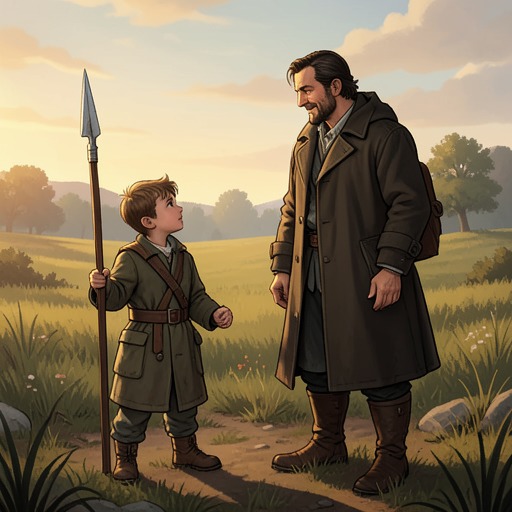
Yadaka introduces the idea when Danny is twelve, an age Molly regards as a threshold between childhood and adulthood. Danny first makes the phrase comic by associating it with his father’s relationship with a woman to the west. Yadaka distinguishes his own meaning from that adult subject, then explains that Danny is only partway toward becoming a man. The exchange sets the teaching in a personal relationship: Yadaka meets the boy’s curiosity with conversation and patient clarification rather than treating maturity as something acquired automatically with age.
The first responsibilities Yadaka names are immediate and domestic. Danny must care for Molly, his brothers and his sister, and fulfill his jobs around the house. This instruction recognizes the work Danny already does: he has described himself as helping his mother while his father is often away. Men’s business therefore begins not with an abstract ideal of masculinity but with accountable conduct toward the people who depend on him.
Yadaka then widens the lesson from household obligations to knowledge carried across generations. Danny is to learn stories of the land, sky, and animals and, in turn, retell them to his sons. This responsibility develops over time, beginning with a walk in the mountains to a sacred place. The teaching makes storytelling an obligation as well as a form of knowledge: what Danny learns is not meant to end with him but to be transmitted onward.
Ceremony, practice, and the first kill
Yadaka describes the final task of this instruction as Danny’s first kill, performed properly. Danny initially closes his eyes at the prospect. Yadaka demonstrates a swift killing action with a spear, emphasizing that the aim is to prevent suffering, then clarifies that the first kill he means is an animal for food. The moment turns a potentially alarming lesson into a concrete account of skill and responsibility: taking life is presented in relation to nourishment and the manner in which the act is carried out.
The teaching is also embodied. When Danny recounts how Molly brought down the wild grey bullock, Yadaka rises and imitates the animal through a traditional Aboriginal dance. His movement gives Danny’s account a new form: the story is no longer only a boy’s spoken recollection but something performed and shared between them. This episode connects men’s business to learning through action and imitation, while the wider novel’s memory of men and boys gathered in painted ceremonial practice places such embodied knowledge within a communal cultural context.
Later, Yadaka offers to take Danny on his first kill with his spear, extending the teaching beyond their initial conversation. Molly answers that there has been enough killing around them already. Her response locates the lesson within the dangers and losses surrounding the family; it also marks a limit on what can be pursued at that moment. Men’s business is thus transmitted amid competing claims of cultural learning, maternal protection, and immediate safety, rather than in a world untouched by violence.
Transmission through the Ngarigo family
The novel’s later account shows the teaching taking root beyond Danny’s private exchange with Yadaka. Danny and his brothers undergo the final stage of their men’s-business ceremony when they are twelve, learning it in the high country with their Ngarigo family. Their Uncle Bulbarai passes the ceremony to them in haste because he knows that ancient practices are under pressure from modern ways. The scene gives the teaching a historical urgency: its continuation depends on people receiving and carrying it forward before the conditions for its practice are further diminished.
Danny and his brothers regard their ability to continue this inheritance as an honour. They take pride in knowledge belonging to their Aboriginal family, and the narrative distinguishes Danny as especially proud while emphasizing that all the brothers defend their culture and countrymen when needed. Men’s business therefore joins personal development to collective belonging. Its responsibilities reach outward from the household to a people and Country whose continuity is endangered.
The later ceremony is not detached from the family’s stories. The Story of the Bullock, first performed for Danny by Yadaka as Danny narrated his mother’s encounter, is eventually taken up by the Ngarigo as part of their practices of mimicry and dance. Men’s business and story transmission meet in this movement from conversation, to performance, to communal inheritance. The account of Molly’s bravery and hardship becomes a means by which the Ngarigo honour her and bring her into the family clan; the children later inherit a story that has already been shaped by several generations of telling and enactment.
The next generation
In the closing family scene, the final stage of men’s-business ceremony awaits Mirribi, Danny and Nell’s eldest son, on his twelfth birthday. He is to learn the ceremony his father and uncles received in the high country from their Ngarigo family. The repetition of the age and the teaching makes Danny’s own threshold into a structure of continuity: what Yadaka once explained to him becomes knowledge he can pass to a son.
That continuity is deliberate rather than secure. The ceremony reached Danny and his brothers because Bulbarai knew time was running out for ancient practices as modern ways invaded and damaged what the Ngarigo held dear. Yet the brothers preserve what they have learned, and their descendants grow up within a family that continues to affirm its Aboriginal inheritance. Men’s business thus appears both as a living tradition and as a response to the threat of cultural loss.
The novel gives that transmission a physical and communal form. Danny’s children stage the Story of the Bullock, with his daughter playing Molly and Mirribi joining in the reenactment. Danny takes up the performance in turn, using his body to imitate the bullock as Yadaka once did. The family play is a simplified version of the story rather than the painted, sung, and danced Ngarigo performance, but it keeps the account in circulation among the children. Through the sequence of teaching, ceremony, story, and reenactment, men’s business connects responsibility to the ongoing transmission of culture, family memory, and belonging to Country.